Punchh Platform Release Notes - 17 February 2026 Deployment
The updates described in these release notes and the affected/linked documentation will not be available in the Punchh platform until the target deployment date.
Smart Passes
Universal Enrollment Link for Google Loyalty Pass
Brands can now use a single, universal Google Loyalty Pass enrollment link across all marketing channels: QR codes, signage, websites, receipts, and in-app surfaces. This link lets new guests enroll directly during pass save, while existing guests can enter their information and download their Google Loyalty Pass without re-enrolling or creating duplicate accounts. This update brings Google Wallet pass distribution in line with the simplicity already available for Apple Wallet. (CAM-7032, PDOC-3576)
See the following article(s) for more details:
- Smart Passes: Overview (Support Portal)
Apple Loyalty Pass, Primary Field Update
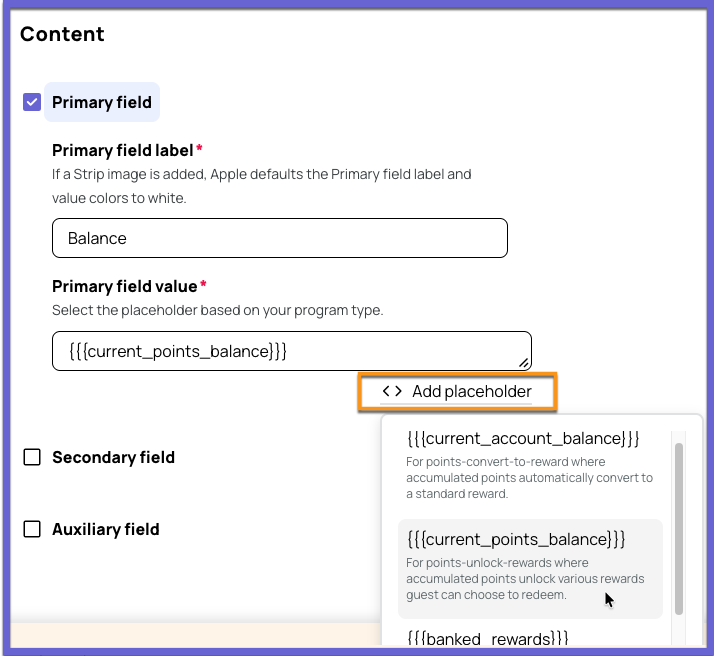
We’ve introduced a new UI enhancement that makes it easier for customers to configure the Primary Field on Apple Loyalty Passes. When selecting the dynamic tag to display on the front of pass, users will now see helpful guidance that clearly explains which tag corresponds to their rewards program model. This update simplifies setup, reduces errors, and ensures members see the correct points or currency values on their passes. Dynamic tags continue to work exactly as before. When a tag is selected from the dropdown, it automatically populates the Primary Field. (CAM-6962, PDOC-3544)
See the following article(s) for more details:
- Apple Passes (Support Portal)
UI Enhancement for Customizing Loyalty Passes
A new dotted outline now highlights the field you're editing in Apple and Google Smart Pass previews. This makes it easier to see exactly which text area is selected, especially over light or busy background images, improving clarity and reducing design mistakes. (CAM-6908)

Campaigns
Control Group in Mass Offer Campaigns
We’ve expanded the power of Mass Gifting campaigns by enabling control groups for every gift type. This creates a more seamless and consistent setup experience, reducing complexity and making campaigns easier to manage at scale. This update ensures a more intuitive experience when designing campaigns, delivers improved targeting accuracy, and unlocks more meaningful insights for smarter decision-making. (EPS-11080, PDOC-3571)
See the following article(s) for more details:
- Mass Offer Campaign (Support Portal)
Loyalty
Redemption Wait Period Upgrade
We have enhanced the Redemption Wait Period configuration to provide greater flexibility and precision by allowing brands to define the wait time in minutes in addition to hours. A new Minutes field has been added, with a default value of 0 minutes. This update is fully backward-compatible, no data migration is required, and existing setups continue to work seamlessly using default values.
To ensure consistent behavior, the system applies clear defaults when fields are left empty. If the Hours field is empty or nil, it defaults to 4 hours; if the Minutes field is empty or nil, it defaults to 0 minutes. For example, leaving hours empty and entering 15 minutes results in a 4 hours 15 minutes wait, while entering 0 hours and 15 minutes results in a 15-minute wait. If both fields are left empty or cleared, the wait period defaults to 4 hours 0 minutes. This update gives brands more control over redemption timing while maintaining safe, predictable defaults. (LPE-1525)
Action Required: Please reach out to your Punchh representative to update your Redemption Wait Period settings for your brand.
Offers
Line Item Selectors Improvements
We fixed an issue in the Line Item Selection (LIS) logic where modifier items could incorrectly qualify when using the “Only Modifiers” Logic. Previously, in some configurations where both base-item and modifier-item conditions were defined, modifier items could pass validation if they matched base-item criteria, even if they did not meet the modifier-specific rules. This could lead to unexpected or incorrect QC results. (OMM-1594)
What’s changed:
- Base-item conditions are now used only to identify the qualifying base item.
- Modifier items are evaluated only against modifier-specific conditions.
- Modifier items no longer inherit or reuse base-item rules during validation.
Benefits:
- More accurate modifier qualification
- QC results now align with the intended LIS configuration
- No changes required to existing configurations; this fix has been automatically applied